A tooth can be developing a problem long before it starts hurting.
That is one of the frustrating things about dental problems. A cavity between two teeth, early bone loss, a damaged filling, or an infection around a tooth may not announce itself with pain. By the time you notice sensitivity or a persistent toothache, the underlying problem may already be more advanced.
This is where modern dental technology can make a meaningful difference.
Digital X-rays, intraoral cameras, advanced imaging, and newer computer-assisted tools give dentists ways to see details that may not be visible during a conventional visual examination.
They do not replace a Glen Allen dentist’s clinical judgment, but they can add information that helps identify, monitor, and evaluate problems earlier.
For patients, that can change the experience of dentistry from “something hurts, so I need treatment” to “we found something early, so we can determine what it needs before it becomes a bigger concern.”
1. Digital X-Rays Can Reveal What the Dentist Cannot See Directly
One of the most important diagnostic technologies in everyday dentistry is still the dental X-ray.
A dentist can visually examine the surfaces of your teeth, but some areas are naturally difficult to inspect. The spaces between teeth are a good example.
A cavity developing between two teeth may be hidden from direct view.
Bitewing radiographs can help dentists evaluate these areas and look for evidence of decay, particularly when the surfaces cannot be adequately examined visually.
Digital radiography also makes it easier to display and store images electronically. Digital imaging can support evaluation of dental caries, oral pathology, periodontal disease, and other clinical conditions.
That does not mean every patient needs an X-ray at every appointment.
Dental X-rays only recommended when clinically necessary, with the patient’s age, oral health, disease risk, and signs or symptoms considered when deciding what imaging is appropriate.
The goal is not more imaging.
The goal is appropriate imaging when it can answer an important clinical question.
2. Intraoral Cameras Turn Hidden Details Into Something You Can See
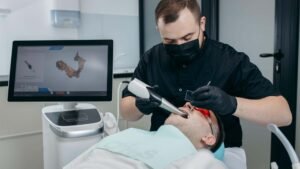
An intraoral camera is a small camera designed to capture detailed images inside the mouth.
Its value is not simply that the camera produces a bigger picture. It can help the dentist and patient examine specific areas of the teeth and gums at a level of visual detail that a mirror alone may not provide.
This can be especially useful for patient education.
Instead of hearing:
“There is a problem with this tooth.”
You may be able to see the area on a chairside screen.
Seeing plaque accumulation, a suspicious area, an old restoration, gum changes, or a fractured tooth can make a dental recommendation much easier to understand.
Intraoral cameras are useful patient-education tools, particularly because enlarged images can help patients visualize conditions such as plaque, stains, and decay.
Intraoral imaging can also create a record that helps the dental team compare findings over time.
That creates an important shift:
A dental appointment does not always have to be a snapshot. It can become part of a visual timeline.
3. Digital Imaging Helps Dentists Compare Changes Over Time
One dental image can tell a dentist a lot.
A series of images can tell a different story.
Suppose an area of concern is small and does not clearly require immediate treatment. Your dentist may need to determine whether it is stable or changing.
Having previous images available can make comparisons more meaningful.
This principle is particularly important in preventive dentistry. Technologies can quantify or monitor changes in tooth structure, while recognizing that different technologies have different capabilities and limitations.
The purpose is not to treat every tiny irregularity.
It is to gather enough information to make a better-informed clinical decision.
That can be especially valuable when your Glen Allen dentist is deciding whether an area should simply be monitored, receive preventive care, or receive restorative treatment.
4. Artificial Intelligence Is Becoming Another Set of Eyes
Artificial intelligence is one of the biggest changes happening in dental diagnostics.
And it is important to understand what that actually means.
AI does not independently replace the dentist. Instead, some dental AI systems analyze images and highlight findings that may deserve closer attention.
AI-assisted analysis of dental images, including systems designed to help analyze two-dimensional radiographs.
The role of validation, safety, transparency, and clinical oversight in the responsible use of AI.
In a July 2026 survey from the ADA Health Policy Institute, 43.3% of responding U.S. dentists reported using AI for at least one task in their practices, while 22.8% reported using AI for imaging and diagnostics.
That does not mean every dental practice uses AI or that AI should determine a diagnosis by itself.
Instead, it shows how quickly computer-assisted tools are becoming part of the broader dental technology landscape.
These systems are intended as adjuncts and do not replace comprehensive clinical evaluation.
5. 3D Imaging Can Answer Questions That 2D Images Cannot
Sometimes a standard dental X-ray is enough.
Sometimes it is not.
Cone-beam computed tomography, commonly called CBCT, creates a three-dimensional representation of dental and facial structures.
Dental CBCT can be used for specific clinical applications including implant planning, evaluation of abnormal teeth, endodontic assessment, dental trauma, and certain cases involving dental caries.
Three-dimensional imaging can help the dentist understand the relationship between structures that overlap on conventional two-dimensional images.
For example, CBCT may be useful when evaluating:
- The position of impacted teeth
- Bone anatomy
- Implant treatment planning
- Certain root canal concerns
- Complex dental or facial conditions
- Certain types of trauma
But more advanced imaging is not automatically better for every patient.
CBCT generally exposes a patient to more radiation than a conventional dental X-ray, so it should be used when the additional information is clinically justified.
Good dental technology is therefore not about using the most sophisticated machine available for every appointment.
It is about choosing the right technology for the question that needs answering.
6. Technology Can Help Find Problems Before They Become Emergencies
Consider two different scenarios.
1. Scenario one: Waiting for pain
A patient notices increasing sensitivity, waits several weeks, develops significant pain, and finally schedules an emergency appointment.
By that point, the dentist may be dealing with a problem that requires more extensive evaluation or treatment.
2. Scenario two: Finding a developing problem early
A routine examination identifies an area that deserves closer evaluation. Imaging provides additional information. The dentist compares it with previous findings and determines whether the area should be monitored or treated.
The patient may never experience significant pain from that particular problem.
That is the real value of early detection.
It is not about creating anxiety over every small finding. It is about giving your Glen Allen dentist information early enough to make thoughtful decisions.
7. Dental Technology Is Especially Useful When Problems Are Difficult to See
Not every tooth problem presents in an obvious way.
Technology can be particularly useful when a dentist needs to investigate:
1. Cavities between teeth
These can be difficult to see directly. Bitewing X-rays are commonly used to evaluate interproximal areas when clinically indicated.
2. Bone changes
Radiographs can provide information about the supporting bone that cannot be obtained from simply looking at the visible portion of a tooth.
3. Root and surrounding structures
Imaging can help evaluate roots and surrounding anatomy when symptoms, examination findings, or treatment planning make additional information necessary.
4. Cracks and damaged restorations
Some dental damage is subtle and may require a combination of clinical examination and imaging to understand.
5. Developing problems in children
Growing mouths change rapidly. Dental imaging may help dentists evaluate tooth development or identify areas that cannot be adequately assessed visually when imaging is clinically appropriate.
The technology does not make the diagnosis by itself.
It gives the dentist more information with which to make the diagnosis.
What Should You Expect During a Technology-Assisted Dental Exam?
Technology should make your appointment more informative, not more confusing.
Depending on your individual needs, an examination may involve a combination of:
- Review of your dental and medical history
- Visual examination of your teeth and gums
- Digital X-rays when clinically indicated
- Intraoral photographs or camera images
- Comparison with previous records
- Additional imaging when a specific clinical question requires it
- Discussion of what the findings mean and what, if anything, needs to happen next
Not every patient needs every technology.
A child, a healthy adult with low cavity risk, someone experiencing dental pain, and a patient preparing for implant treatment may require very different diagnostic approaches.
That individualized approach is an important part of responsible dental care.
The Most Useful Dental Technology May Be the Technology You Understand
A high-resolution image is only helpful if it leads to better communication and better decisions.
One of the strongest advantages of digital dentistry is that it can make the invisible more visible.
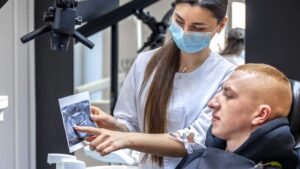
A dentist can show you an area between teeth on an X-ray. An intraoral camera can enlarge a questionable area. Digital records can make changes easier to compare. In selected cases, 3D imaging can reveal anatomical relationships that ordinary images cannot show clearly.
You become part of the conversation rather than simply being told what was found.
That can make preventive care more understandable and treatment decisions more informed.
What Dental Technology Cannot Do
Despite how advanced dentistry has become, technology has limits.
No scanner, X-ray, camera, or AI system can guarantee that every future dental problem will be detected before it causes symptoms.
Some conditions may be too early to identify reliably. Some findings require clinical context. Some technologies are useful only for specific situations.
The ADA’s current AI guidance emphasizes that image-analysis systems are intended to support clinical decision-making rather than replace the dentist’s judgment.
This is an important principle to remember:
Technology improves the information available to your dentist. It does not replace the dentist.
FAQs About Dental Technology and Early Detection
Can dental X-rays find cavities before they hurt?
They can help identify certain cavities, particularly those between teeth, before they become symptomatic. However, not every cavity is visible on an X-ray, and imaging should be interpreted alongside a clinical examination.
Are digital dental X-rays safer than traditional film X-rays?
Digital radiography can offer advantages such as efficient image processing and communication. However, the key safety principle is that X-rays should be taken when clinically necessary and with exposure kept as low as reasonably achievable.
Can an intraoral camera detect cavities?
An intraoral camera can provide highly detailed visual images that help a dentist inspect and document teeth and gums. It is an additional diagnostic and communication tool rather than a replacement for clinical examination or appropriate radiographs.
Does AI diagnose cavities?
Some FDA-cleared dental AI systems are designed to assist dentists in identifying potential carious lesions on radiographs. They are intended as adjuncts and do not replace the dentist’s comprehensive evaluation.
Does everyone need 3D dental imaging?
No. 3D dental imaging is generally reserved for situations where three-dimensional information is clinically useful. Because 3D dental imaging typically involves more radiation than conventional dental X-rays, its use should be justified by the patient’s individual needs.
Can dental technology prevent tooth pain?
Technology itself does not prevent pain. Its value is that it can help identify certain problems earlier, allowing the dentist to evaluate them before they potentially progress into more serious or symptomatic conditions.
The Goal Is to Find Problems Before They Become Your Emergency
Dental technology has changed what a dentist can see.
Digital X-rays can reveal areas hidden between teeth. Intraoral cameras can magnify details that are difficult to appreciate with a mirror alone.
Digital records can help track changes. 3D imaging can provide additional anatomical information when it is clinically appropriate. And AI-assisted image analysis is becoming another tool dentists can use to support radiographic interpretation.
But the real advancement is not the technology itself.
It is the ability to combine better information with professional judgment before a small concern becomes a painful one.
That is why keeping routine dental examinations matters even when your teeth feel completely normal. Pain is a warning sign, but it should not be your first reason to visit the dentist.
Preventive, Technology-Supported Care in Glen Allen
At Village Family Dentistry, we believe dental technology should serve a simple purpose: helping patients understand their oral health and helping our team identify concerns as early as possible.
Our practice uses digital X-rays and intraoral cameras as part of a comprehensive approach to diagnosis and preventive care.
Whether you are due for a routine examination, concerned about a tooth that does not hurt yet, or want a clearer understanding of what your dental images show, our team can evaluate your individual needs and explain the findings in straightforward terms.
If you have been putting off a dental checkup because everything feels fine, this may be the right time to schedule a preventive visit with a Glen Allen dentist at Village Family Dentistry.